
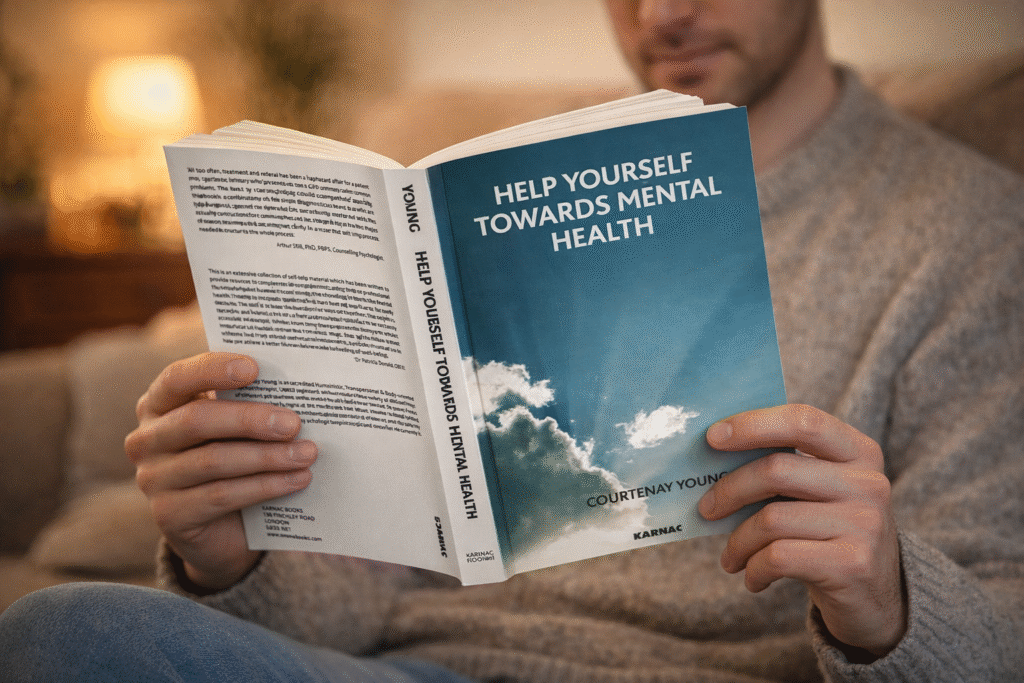
It can be ordered (with a £1.50 discount and free postage)
A comprehensive guide to how an individual can help themselves resolve a wide variety of mental health issues and life problems.
‘This is an extensive collection of self-help material, which has been written to provide resources to complement self-exploration or professional counselling. The knowledge has been built up through years of working in the field of mental health, listening to patients, and searching for the materials that could make a difference. The skill is in how the handouts have been put together to be easily accessible and helpful, and in a format that allows flexibility and tailoring to the individual. The attitude of current evidence-based guidelines is to support a range of self-help approaches and talking therapies to enable people to achieve better mental health, rather than turning to drugs. This is therefore a most welcome tool from which patients will benefit, and indeed, we could all use to help us achieve a better life/work balance and feeling of well-being.’ – Dr Patricia Donald, MBE
‘Courtenay Young presents a contemporary view of therapy and counselling as accessible and relevant and not distant or precious. The book will interest seasoned professionals and students alike. It will also be a significant addition to the self-help mental health literature.’
- Andrew Samuels, Professor of Analytical Psychology, University of Essex
‘All too often, treatment and referral has been a haphazard affair for a patient who comes to a GP or primary carer with common psychological problems. This book by Courtenay Young could change this dramatically. It provides a combination of a few simple diagnostic tests and a lot of self-help handouts, geared closely to what GPs are actually confronted with. The detailed instructions for combining these in decision making at the first stages of treatment are laid out with great clarity in a way that will bring a much needed structure to the whole process.’
- Arthur Still, PhD, FBPsS, Counselling Psychologist
This Handbook (consisting of about 560 pages) is designed specifically for people with depression, anxiety or with issues of low self-esteem. Unfortunately these problems seem to be very widespread and are often also associated with mental health, stress and other issues. They are also (often) compounded by a multitude of problems stretching over someone’s whole life. Whilst these notes & suggestions are not able to touch on some of these deeper and much more painful issues, they can be very helpful as a way of getting ‘started’, and can be understood and used simply and successfully by most people. The range has been made as wide as possible and the language chosen to be relevant and accessible. That is not to say the actual self-help ‘work’ of moving towards better mental health is easy: of course it is not; it involves insight, and change, and practice, and …
In a 7-year period, since moving to the Edinburgh area in 2003, Courtenay has been referred over 750 new clients in GP surgeries, Depts of Clinical Psychology, and as private clients. This collection of hand-outs were developed as a result of all these referrals, and in the process of trying to respond to the clients’ needs, given limited resources. Each hand-out was originally either printed out there-and-then and given to the patient, or sent to them by e-mail shortly after the session … The book is a compilation of these hand-outs, adapted into this format.
Hopefully there may also be a clinician’s version, at some point, which will be able to print out separate pages and which has the internet links (for further information) embedded in the text. This could make it extremely useful for doctors and other clinicians.
Parts of this book have already been adapted into separate leaflets “Stress for Health Professionals”; with other parts being adapted for “How to Cope with …” leaflets on “Anxiety”, “Depression” and “Stress” for clients in GP surgeries, and for the MoodJuice website. These are also available.
More details about this book can be obtained by contacting Courtenay Young at: enquiries’at’courtenay-young.com (please replace the ‘at’ with @)
| No. | Title |
|---|---|
| 1 | SELF-HELP & STEPPED CARE |
| 2 | A GP COUNSELLING SERVICE |
| 3 | PSYCHOTHERAPY, PSYCHOLOGY & PSYCHIATRY |
| 4 | MENTAL HEALTH ASSOCIATIONS |
| 5 | STRESS |
| 6 | THE PHYSIOLOGY OF STRESS |
| 7 | SELF-HELP PRINCIPLES |
| 8 | MORE SELF-HELP WITH STRESS |
| 9 | FITTING EXERCISE INTO YOUR LIFE |
| 10 | DIFFERENT TYPES OF EXERCISE |
| 11 | FITTING MORE RELAXATION IN YOUR LIFE |
| 12 | THE WIDER PICTURE |
| 13 | LIFE EVENT STRESS INVENTORY |
| 14 | DOLPHIN STRESS TEST |
| 15 | ABOUT DEPRESSION |
| 16 | SELF-HELP FOR DEPRESSION |
| 17 | MORE SELF-HELP TECHNIQUES |
| 18 | WORKING WITH DEPRESSION |
| 19 | FOODS FOR DEPRESSION |
| 20 | WHAT NOT TO EAT OR DRINK |
| 21 | SOMATIC ASPECTS OF DEPRESSION |
| 22 | DIFFERENT VIEWS OF DEPRESSION |
| 23 | POINTS TO REMEMBER |
| 24 | EMOTIONAL EXPRESSION IN DEPRESSION |
| 25 | THOUGHTS & MOODS IN DEPRESSION |
| 26 | NEGATIVE EMOTIONS |
| 27 | WORKING WITH NEGATIVE EMOTIONS |
| 28 | THINKING DISTORTIONS IN DEPRESSION |
| 29 | COMMON IRRATIONAL BELIEF SYSTEMS |
| 30 | HOW TO CHANGE YOUR NEGATIVE THINKING |
| 31 | ABOUT ANTIDEPRESSANT DRUGS |
| 32 | A PROGRESS CHECK |
| 33 | ANXIETY |
| 34 | SELF-HELP FOR ANXIETY |
| 35 | FURTHER RELAXATION: BEING PEACE |
| 36 | ABOUT PANIC ATTACKS |
| 37 | WORKING WITH PANIC ATTACKS |
| 38 | TIPS TO PREVENT PANIC ATTACKS |
| 39 | ANGER MANAGEMENT |
| 40 | SLEEP ISSUES |
| 41 | TOWARDS BETTER SLEEP |
| 42 | MENTAL HEALTH ISSUES AT WORK |
| No. | Title |
|---|---|
| 43 | SELF-ESTEEM |
| 44 | SELF-ESTEEM STRATEGIES 1 |
| 45 | SELF-ESTEEM STRATEGIES 2 |
| 46 | SELF-ESTEEM STRATEGIES 3 |
| 47 | SELF-ESTEEM STRATEGIES 4: BECOMING MORE ASSERTIVE |
| 48 | THE “RIGHTS CHARTER” |
| 49 | WHAT WORKS |
| 50 | WHAT WORKS FOR ME |
| 51 | LEGITIMATE NEEDS |
| 52 | EXPRESSING YOUR NEEDS |
| 53 | RESPONDING TO CRITICISM |
| 54 | WIDER PERSPECTIVES |
| 55 | SELF-AWARENESS |
| 56 | WEIGHT, BODY IMAGE & EATING ISSUES |
| 57 | CHRONIC FATIGUE SYNDROME |
| 58 | 12-STEPS PROGRAMME |
| 59 | BEREAVEMENT & GRIEVING |
| 60 | INFORMATION FOR CARERS & FAMILIES |
| 61 | HAVING TO CARE FOR OTHERS |
| 62 | PARENTS AT HOME, PARENTS AT WORK |
| 63 | RELATIONSHIP PROBLEMS |
| 64 | DIVORCE & SEPARATION |
| 65 | DIVORCE & SEPARATION: DOs AND DON’Ts |
| 66 | THE PATH TO MENTAL HEALTH |
| 67 | THE ROAD TO CHANGE |
| 68 | HEALING THE PSYCHIC WOUND |
| 69 | MONEY WORRIES |
| 70 | AGING |
| 71 | SELF-HARM ISSUES |
| 72 | TRAVEL |
| 73 | HEADACHES & MIGRAINES |
| 74 | PSYCHIATRIC HELP-LINE (Joke) |
| 75 | SELF-ESTEEM GROUPS |
| 76 | SELF-ESTEEM EXERCISES 1–6 |
| 77 | APPENDIX 1: RELAXATION TECHNIQUES & THE AUTOGENIC TECHNIQUE |
| 78 | APPENDIX 2: MEDICAL INFORMATION ON THE WEB & OTHER SELF-HELP BOOKS |
| 79 | REFERENCES & CONTACTS |